

Since 2024
Replacing per-request paid APIs with our own reference data
Addresses, public transport, property sales, land registry: four services answering the same questions as paid APIs, built from open public data, running on our servers.
street numbers, France and five neighbouring countries
metro, tram, train and bus stops
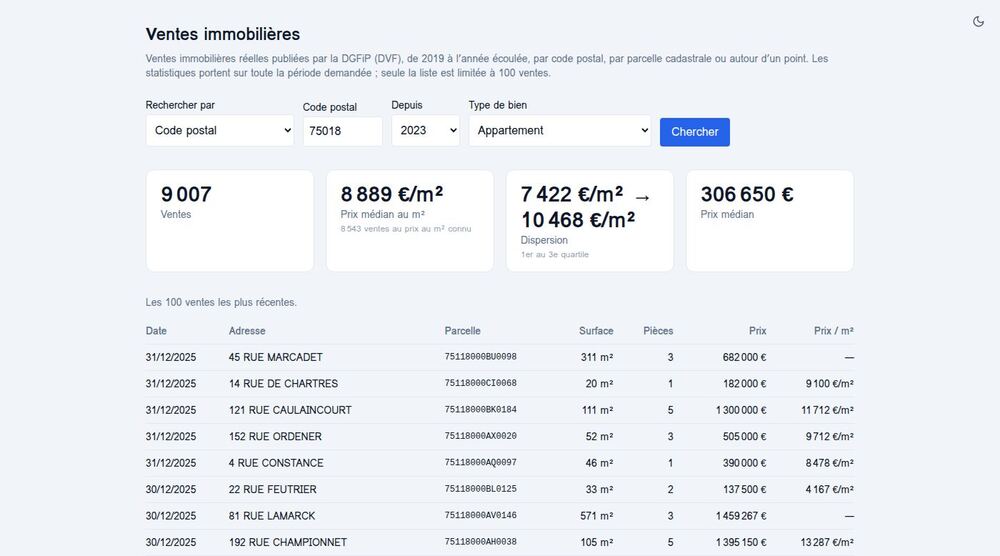
real property sales published by the French tax authority
of third-party API billed per request
The context
A property application asks the same questions over and over: does this address exist, what transport is nearby, what does this area sell for, which land parcel. Every answer used to be bought per request, or asked of a free public service — until one started billing by volume and the other banned the caller for heavy use. The data itself is open and downloadable by anyone.
The workflow, in motion
Three public files, one address
The same questions kept coming back — does this address exist, what transport is nearby, what does this area sell for. Every answer was bought per request, or begged from a free service that ended up banning us.
Addresses
French national address base + OpenStreetMap
Transport
OpenStreetMap, eleven country extracts
Property sales
DVF, published by the French tax authority
Mirror reloaded every day
The public files are downloaded and reindexed every night, on our servers, with no manual step.
GET /api/search?q=8 rue de Rivoli 75004A property page: its verified address, the transport around it, its land parcel.
A price estimate: the area's median per square metre and its spread.
€0
of third-party API billed per request — and a service nobody else can switch off.
Adding a country means adding the line for its extract: no column, no migration, no application to change.
What we did
- A mirror of the public sources, rebuilt every day: national address base, OpenStreetMap extracts, DVF property sales, land registry.
- Geocoding and address autocomplete, replacing a service billed per request.
- Transport stops around a point, replacing the public API that had ended up banning the application for heavy use.
- The prices actually paid in an area, with the median per square metre and its spread, computed from official sales records.
- Operations: daily loads, monitoring, and an alert when a source stops answering.
What changed
- The third-party API bill is gone, and with it a cost that grew with traffic.
- The service can no longer be cut off by a third party — that is what triggered the work.
- Adding a country means adding the line for its extract: no column, no migration, no application to change.
- Requests no longer leave the network: response time no longer depends on someone else's availability.
The services involved
This engagement drew on the following expertise. Each has its own page, with its method and its deliverables.
Other case studies
FlatBay
Since 2015Agencies drowning in incomplete files. An assistant that chases missing documents, computes the affordability ratio, and only passes on complete applications.
Read the case study
Andrée Putman
Since 2025Reissued furniture, interior architecture projects, collaborations: a bilingual site that shows a body of work and sells pieces, without keeping visitors waiting.
Read the case study
Gextra Academy
Since 2026The vendor was cutting off access: courses, materials and assessments would have left with the subscription. Everything was recovered, then put back in service on a platform the organisation owns.
Read the case studyLet's talk about your project
Thirty minutes is enough to tell whether we are the right fit. We reply within 48 hours, and we say no when it is not for us.